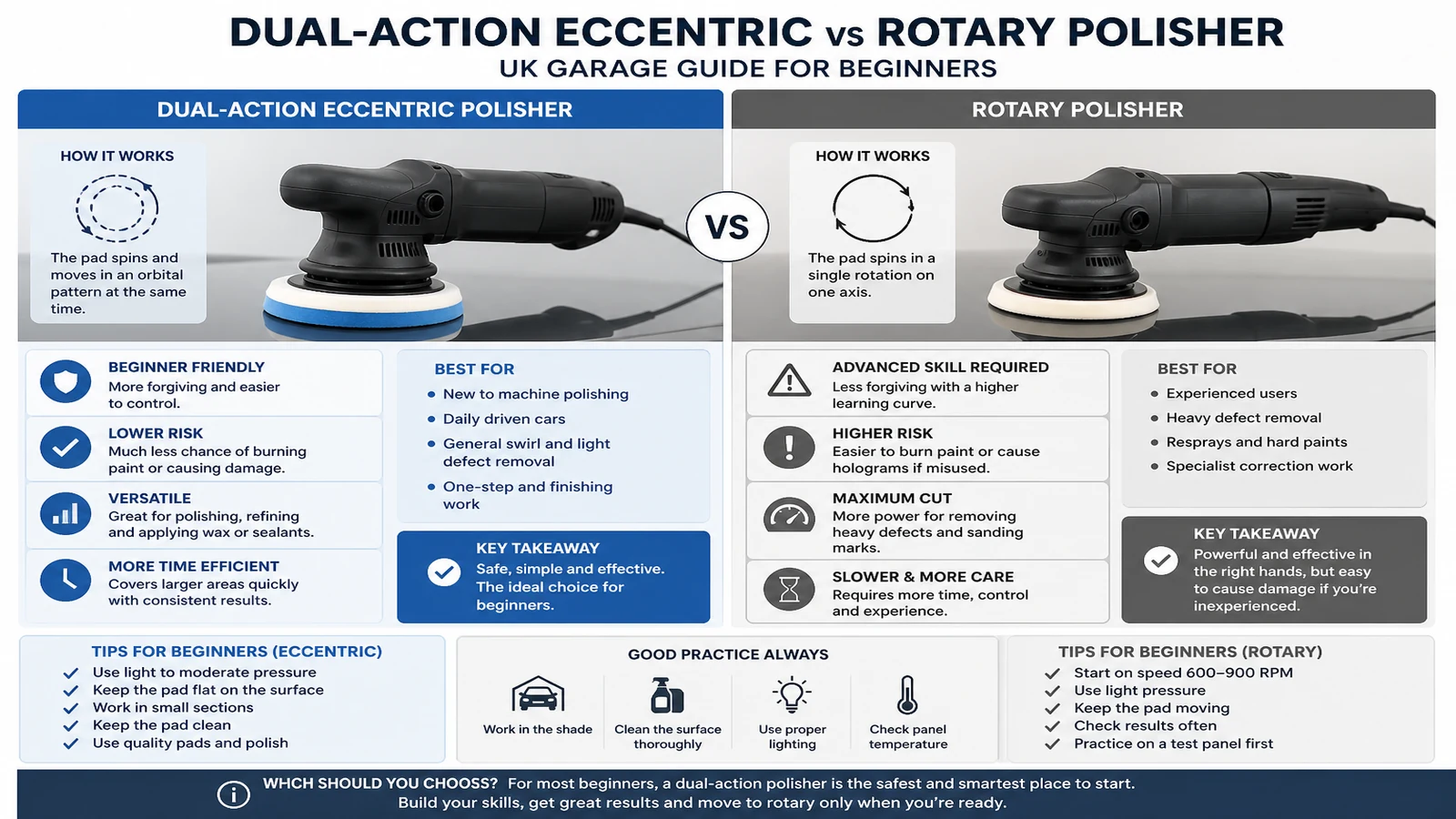
Short answer: DA and rotary polishers differ first in how the pad moves, not in the colour or price of the housing. A dual-action or eccentric machine combines orbit with rotation, while a rotary machine follows a direct spin axis. That distinction changes how a beginner should think about control, heat and test areas, but it does not guarantee a safe result or remove the need for training. BufferKit lists an eccentric cordless polisher with one battery and one charger. The manufacturer does not publish a technical movement diagram or correction result for this specific set, so use mechanism as one buying factor rather than a promise.
Key takeaways
- DA or eccentric describes a movement pattern; it does not guarantee a result.
- Rotary and DA choices should be matched to experience, surface and control needs.
- The BufferKit set is listed as eccentric, not rotary, with one battery and one charger.
Orbit and direct spin in plain English
A DA or eccentric polisher moves the backing plate on an orbit while the pad also rotates. Depending on the machine and load, that rotation can slow or stall. A rotary polisher turns the pad around one direct axis. The mechanism descriptions are useful for understanding the learning task, but they are not a substitute for the exact machine manual.
The practical beginner question is how much control you have when the pad reaches an edge, a curve or a surface with uncertain condition. Do not treat any mechanism as automatically harmless. Pressure, pad, product, paint condition and movement all affect the outcome.
| Comparison | DA or eccentric | Rotary |
|---|---|---|
| Movement | Orbit with rotation | Direct spin axis |
| Beginner focus | Learn steady movement and inspection | Manage direct rotation, pressure and heat |
| Product-page proof | Mechanism may be named | Must be confirmed for the exact model |
Why beginners often prefer a DA format
A DA or eccentric format can feel more approachable because the pad movement is not described as a fixed direct spin. That does not prove that a particular machine is easy to control, nor does it confirm how it behaves under pressure. Beginners still need a small test area and a willingness to stop.
A rotary may be appropriate for a trained user with a specific correction workflow. It may be a poor first choice when the buyer has not learned how to read paint, manage edges or inspect heat. The right answer depends on experience and the work, not a universal label.
- Decide whether this is your first machine-polishing session.
- Choose a small, less visible test area.
- Read the exact operating and accessory instructions.
- Stop and inspect before increasing the scope of the work.
Where the BufferKit set fits
The BufferKit product page names an eccentric polishing mechanism and a rechargeable lithium-battery power format. It presents the yellow selected configuration as a four-piece set with one battery and one charger at GBP 55.24 including VAT. Those facts place it in the cordless eccentric category described above.
The manufacturer does not specify speed range, orbit size, pad diameter, backing plate, vibration value or correction ability. Therefore the listing cannot prove that it is burn-proof, swirl-removing or suitable for every paint surface. Compare the documented mechanism with the job, then ask about the missing accessories.
- Confirmed: eccentric mechanism.
- Confirmed: cordless lithium-battery power format.
- Not confirmed: a particular correction result or heat behaviour.
- Not confirmed: the technical values needed for a direct machine comparison.
Limits and checks before buying
For a beginner, choose the machine whose instructions, accessories and workspace you can understand. Ask for the full four-piece contents list and do not infer a pad or backing plate from a product image. If the answer depends on a specification the manufacturer does not publish, keep it as unknown.
Repeated machine use also brings vibration and eye-protection questions. HSE provides guidance on hand-arm vibration and task-specific PPE. Those sources support safe planning, but they do not certify this product or supply missing performance figures.
Related guides and product details
Start with the movement you can learn and the specifications you can verify; the eccentric label is a useful clue, not a safety or finish guarantee. Read Eccentric polisher for car beginners: a careful UK buying guide for related guidance. Read How to use a dual action polisher for beginners UK: first session for related guidance. Review the documented specification on the Yellow cordless eccentric polisher set with one battery product page before ordering.
Sources and safety context
- Supports the BufferKit mechanism and named power items. Yellow cordless eccentric polisher set with one battery details.
- Supports managing vibration exposure from hand-held tools. Hand-arm vibration.
- Supports matching eye protection to task hazards. Using personal protective equipment to control risks at work.