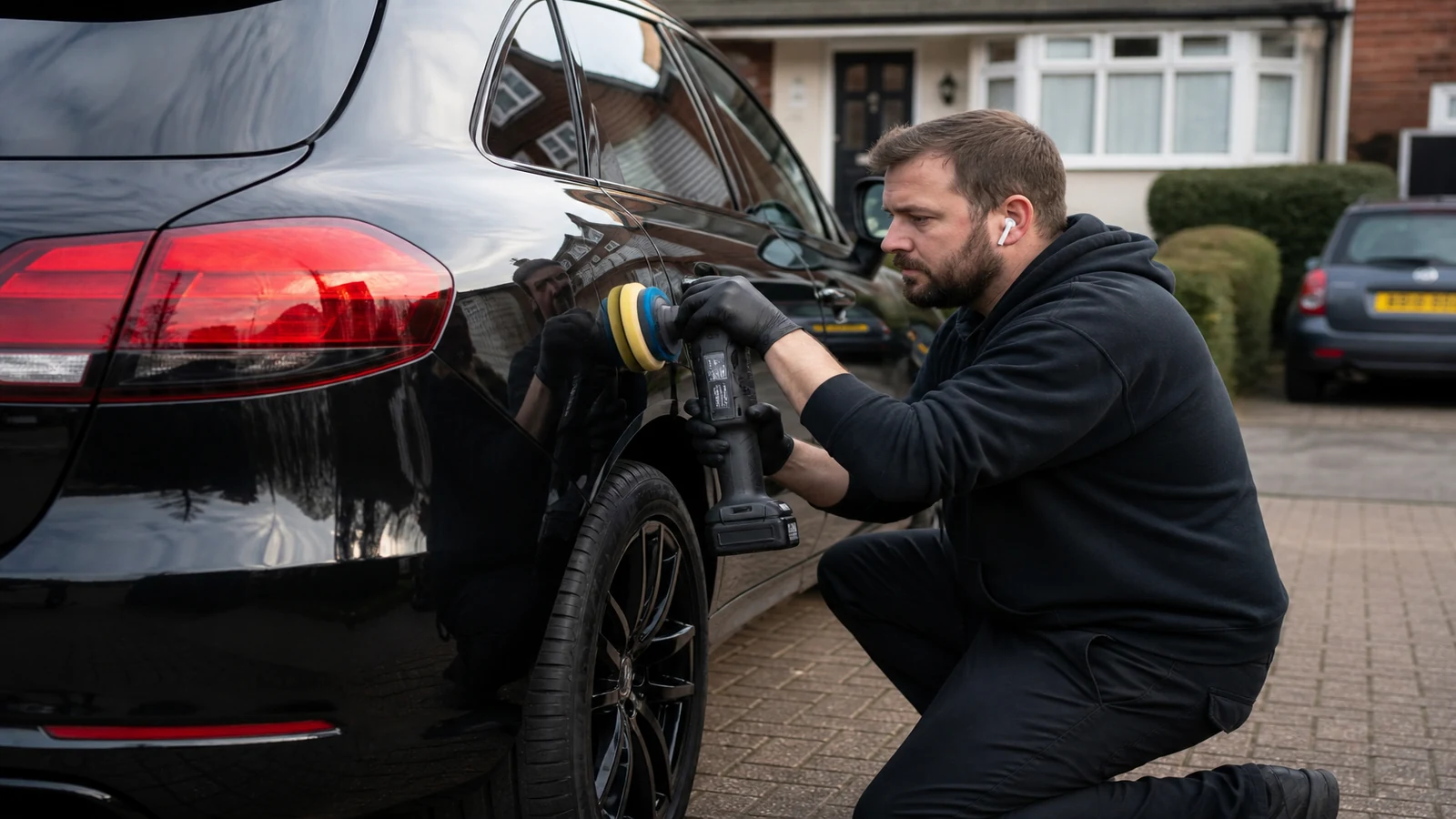
Short answer: A cordless car polisher can make driveway detailing easier when a mains cable would cross a walking route, reach wet ground or fail to reach the rear of the car. It does not remove the need to plan the surface, accessories, battery and stopping points. BufferKit lists a yellow eccentric polisher with a rechargeable lithium-battery power format, one battery and one charger in a four-piece configuration. The page does not publish runtime or charging time, so a sensible driveway plan uses small panel batches and leaves room for a recharge. Mobility is the benefit; it is not a whole-car performance claim.
Key takeaways
- Lay out the driveway so people, cables and charging equipment stay clear of the work area.
- Use the listed one-battery setup for planned batches, not an assumed uninterrupted whole-car session.
- Check the product page for compatible accessories because the remaining two pieces are not fully named.
Why the driveway changes the decision
Driveways vary more than product pages do. A narrow frontage, shared path, sloping surface or nearby rainwater can change how safely you can move around a car. Cordless power removes one lead from that layout, but it does not make the area automatically suitable for machine polishing.
Before unpacking, decide where the car will stay, where the battery will be charged and how you will keep people away from the test area. Keep the charger in a dry place and do not position it where a door, trolley or footstep can pull on the cable.
| Driveway factor | Practical check |
|---|---|
| Walking route | Leave a clear path around doors, gates and the front of the car. |
| Weather | Do not charge or use equipment where rain or spray can reach it. |
| Lighting | Use enough light to inspect the panel before and after a test pass. |
| Session size | Choose one or two defined panels rather than promising the whole vehicle. |
Plan panels around one battery
The listed yellow configuration includes one battery and one charger. The manufacturer does not specify battery capacity, charge time or runtime, so you cannot calculate a reliable number of panels from the product page. Plan a short session, note where you stop and charge only according to the supplied instructions.
A useful batch might be one test area, one bonnet half or another clearly bounded section. The correct batch depends on the vehicle, product, pad and technique. Treat the recharge break as part of the plan rather than as evidence that the tool has failed.
- Choose the panels you can inspect and finish without rushing.
- Charge the named battery with the supplied or specified charger.
- Prepare the surface and keep the machine, pad and cloths organised.
- Stop at a clear panel boundary and record what remains.
Keep the first driveway session controlled
Wash and dry the car before assessing the paint. Pick a small, low-consequence test area and confirm the pad and polishing product before use. Keep the machine movement even and avoid treating the absence of a cable as permission to work quickly or press harder.
If residue, dust or product splashes could reach nearby surfaces, protect the area and wear suitable eye protection for the hazard. HSE says eye protection should match risks such as impact, dust and splash. Choose PPE for the actual task and make sure it fits.
- Clean the panel and check it in suitable light.
- Keep the battery and charger away from water and loose metal items.
- Use only confirmed compatible accessories.
- Stop for a wipe and visual check before moving to another panel.
Limits and checks before buying
The product page confirms the eccentric mechanism, lithium-battery format, one battery and one charger. It does not confirm pad sizes, backing-plate details, speed range, noise, weight, runtime or a finish on a particular paint system. Those details matter if your driveway job is more ambitious than occasional testing.
For paid or frequent work, ask for vibration information and operating guidance. HSE guidance covers hand-arm vibration from hand-held power tools. If the seller cannot supply information that affects safe planning, keep the job smaller or choose a better-documented tool.
Related guides and product details
Use the cordless format when it solves a real driveway-layout problem, then keep the job to documented accessories and realistic battery batches. Read Cordless car polisher UK: check the product facts before choosing for related guidance. Read Cordless polisher for driveway detailing: a practical UK setup check for related guidance. Review the documented specification on the Yellow cordless eccentric polisher set with one battery product page before ordering.
Sources and safety context
- Supports the product facts and named power items. Yellow cordless eccentric polisher set with one battery details.
- Supports matching eye protection to impact, dust and splash hazards. Using personal protective equipment to control risks at work.
- Supports vibration planning for repeated hand-held tool use. Hand-arm vibration.