
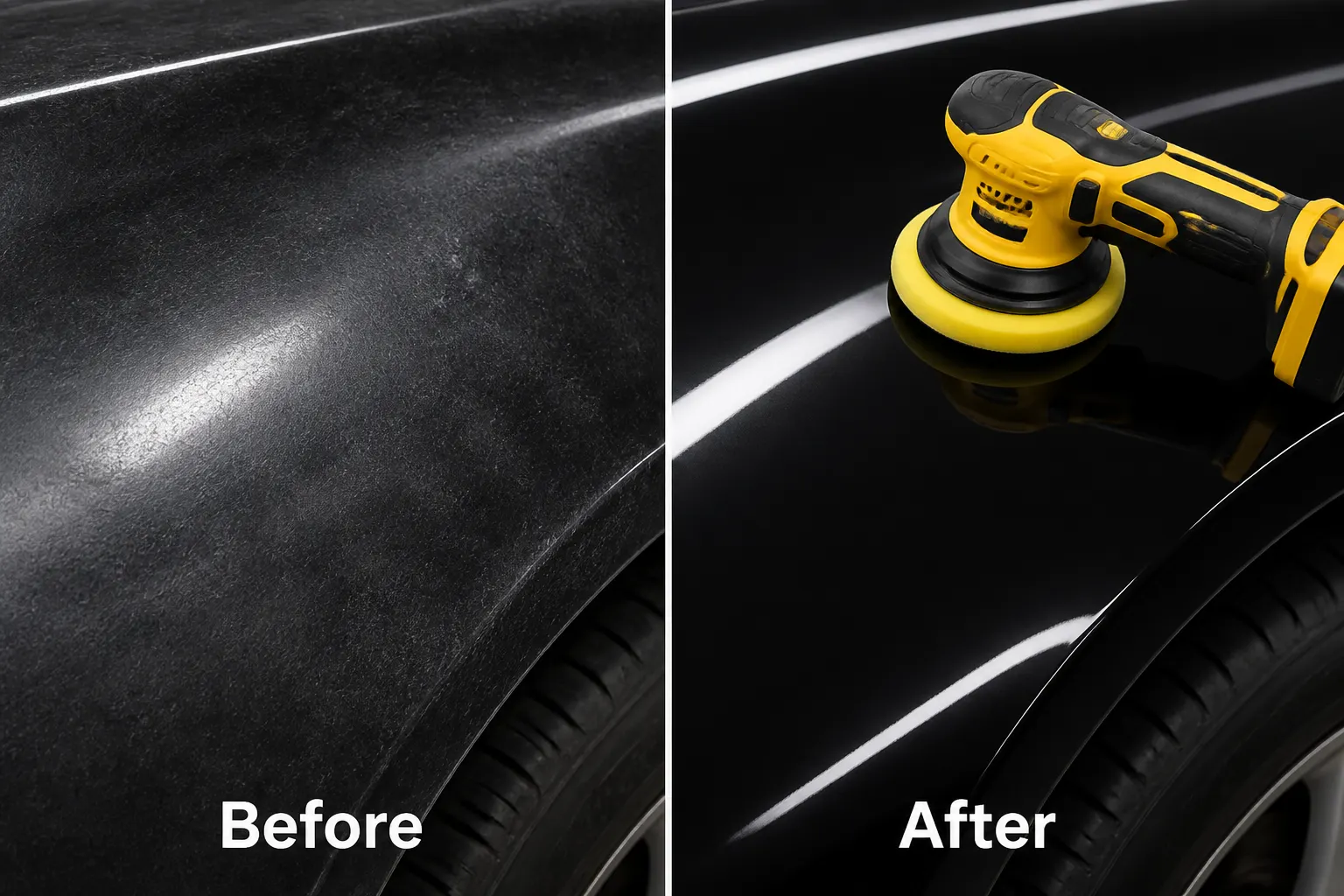
Short answer: A cordless polisher for driveway detailing is most useful when the driveway layout is the problem: no convenient socket, a long route around the car or a cable that would cross where people walk. The battery format does not decide the whole job. You still need a clean test panel, compatible accessories, safe charging and a plan for stopping. BufferKit lists a yellow eccentric polisher set with one battery and one charger in a four-piece configuration. Because the manufacturer does not specify capacity, charging duration or runtime, use short batches rather than planning a guaranteed whole-car session.
Set up the driveway before the tool
Park where you can open the doors and walk around the vehicle without stepping into a public path. Remove loose items that could catch a pad or charger lead, and decide where cloths, polish and the battery will sit. The cordless benefit is easier movement, but a disorganised driveway can still create trips, spills and rushed work.
Do not charge or use the battery where rain, spray or cleaning water can reach it. If the weather changes, stop and move the equipment to a suitable place. A driveway is a work area only when it can remain dry and controlled.
- Park on a stable surface with room to move.
- Separate the charging area from water and traffic.
- Choose one test panel and prepare suitable lighting.
- Keep people and pets out of the immediate work zone.
Plan the cordless session honestly
BufferKit lists one battery and one charger in the selected yellow four-piece configuration. The manufacturer does not specify capacity, runtime or charge duration. That means the product page cannot support a promise such as a full car on one charge or a fixed number of panels.
Instead, set a stopping point before you begin. A small test area or one panel section gives you a clear place to wipe, inspect and decide whether to continue after the battery is recharged. Keep notes so the next session starts with an actual boundary rather than a guess.
| Session choice | Why it is useful |
|---|---|
| Small test area | Shows how the selected accessory and product behave. |
| One panel section | Makes battery and inspection planning easier. |
| Whole car promise | Avoid because runtime and capacity are not published. |
Work cleanly and protect your eyes
Wash and dry the panel, inspect the paint and confirm that the chosen pad and product are suitable. Keep the machine level and follow the exact operating instructions supplied for the model. Do not use a missing accessory simply because it appears to fit.
HSE says eye protection should be selected for the hazard, including impact, dust or splash. Choose suitable protection when the task creates those risks, and keep it clean enough to see the panel clearly. The manufacturer does not specify a PPE package with the product.
- Keep the battery and charger dry.
- Use a confirmed pad and backing plate.
- Stop if the pad loads, skips or the surface condition becomes unclear.
- Wipe and inspect before moving to another section.
Limits and checks before buying
The product page confirms the eccentric mechanism, rechargeable lithium-battery format, one battery and one charger. It does not confirm the remaining two pieces, speed controls, vibration value, weight, noise, pad size or runtime. If your driveway job depends on any of those details, ask before ordering.
For repeated hand-held tool use, HSE guidance is a useful reminder to manage vibration exposure. The BufferKit page does not publish the data needed to calculate exposure for this specific tool, so the manufacturer does not specify a safe duration.
Related guides and product details
A cordless driveway setup can be practical when movement matters, provided you keep the session small and the unknown specifications visible. Read DA vs rotary polisher for beginners UK: compare movement before buying for related guidance. Read Eccentric polisher for car beginners: a careful UK buying guide for related guidance. Review the documented specification on the Yellow cordless eccentric polisher set with one battery product page before ordering.
Sources and safety context
- Supports the named product facts and power items. Yellow cordless eccentric polisher set with one battery details.
- Supports task-specific eye protection advice. Using personal protective equipment to control risks at work.
- Supports caution around repeated hand-held tool use. Hand-arm vibration.